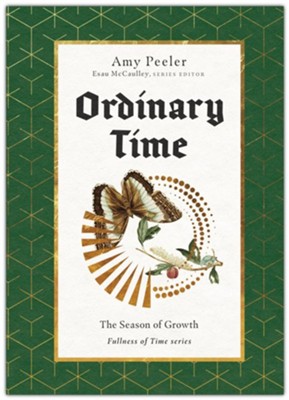
I recently finished, Ordinary Time: The Season of Growth, by Amy Peeler. This is the final book in the Fullness of Time Series covering the yearly liturgical church calendar. Ordinary time is the longest time on the liturgical church calendar and runs from Pentecost to Advent, covering almost 6 months of the liturgical church calendar.
Here are some quotes from the book.
- A perceptive man in my Sunday school class recently observed that some traditions speak about “asking Jesus into your heart,” while ours proclaims, “This is the body of Christ,” over a piece of bread that we then take into our mouths. All Christians have found ways to follow Jesus’ message that God’s Word should be internalized (e.g., Mark 7). All Christians aim to receive the promise of the New Covenant that God will plant the good law of God in our hearts and minds (Jeremiah 31:33; Hebrews 8:10). The Eucharist is a tangible way to enact this internalization.
- The Revised Common Lectionary provides two tracks for the Scriptures read in the worship service each Sunday during Ordinary Time. In one system, the Old Testament passage is chosen to align with the theme present in the Gospel reading. In the alternative option, the readings move chronologically through the Old Testament: one year focuses on the Pentateuch, one on the history and Wisdom literature, and one on the Prophets. In this path, at the end of three years, congregants have gained a decent sense of the scope of the first testament’s story.
- In Christian experience, instead of preparing a meal for God, God prepares a meal for us and invites us to come to his table, where he gives the most lavish feast of all: his own body and his own blood. When we come to this table, we can see ourselves as clearly as God sees us, as honestly as God saw Sarah—sinful yet blessed, always bearing God’s image.
- That daily faithfulness is when trust, even in the face of death, becomes our new ordinary.
Leave a Reply