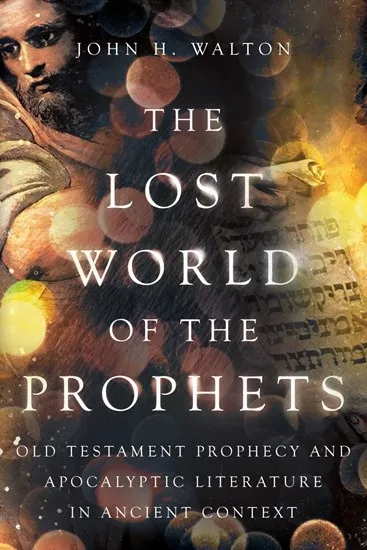
I have read all of the Lost World books by John Walton. Dr. Walton studies the Old Testament and the Ancient Near East culture. His books make serious biblical scholarship accessible. I highly recommend the Lost World books.
In The Lost World of the Prophets: Old Testament Prophecy and Apocalyptic Literature in Ancient Context, John Walton challenges the popular idea that prophets were Godly fortune tellers.
Here are some quotes from the book.
How do the books of the prophets function as meaningful Scripture today? To help us answer this question, I contend that there is a “lost world” connected with prophecy that needs to be recovered in order to guard against misunderstanding. Moreover, from observing the many ways that prophetic texts are used and sometimes misused in popular contexts and in churches, I maintain that a book recovering that lost world is needed to discern the purpose of these prophetic books and prevent us from misunderstanding and misuse.
The details of interpretation are worked out in accordance with a consistently applied methodology that finds God’s authoritative message in the text as being contained in the communication as it was understood by the human instruments (speakers or writers) and their audience(s). In this way these books are working out the principle that the Bible is written for us but not to us.
The key to this approach is the conviction that in order to submit ourselves to the authority of Scripture we need to attend to the author’s literary intentions. We are not able to read his mind, nor do we seek to apply psychoanalysis. We simply assume that he is a competent communicator capable of effectively conveying literary intentions. If God has used such human beings as instruments of his communication, we gain access to God’s message by understanding the author’s message. If we seek to be accountable to God, we must do so by being accountable to the human instruments that he has chosen because he has vested them with his authority. If we choose to pursue a meaning that the human instruments had no knowledge of, we would be obliged either to accept that we are pursuing something without authority or to offer an alternative proposal for the source of authority. In other words, if we do not get our interpretation from the author’s literary intentions, what is the source, and why should we trust it? If we are not receiving it from the authors of Scripture, in what way are we being faithful readers? Ethical reading respects the author’s intentions.
Whatever the author intends carries the authority of God. For our purposes, however, the inverse of that statement may be even more important: if it is acknowledged that the author does not intend a particular aspect of the message that we would like to propose, then we must reevaluate whether that aspect can be maintained and why we should consider maintaining it.
I have argued elsewhere that it is not the Bible’s objective to provide a comprehensive system of morals or theology, though at times its content is pertinent to both. The Bible is not trying to direct us to the will of God for making the important decisions of life (who to marry, what job to take, what vocation to pursue). It is not recounting history or unfolding science. And it is not encoded to tell the future. It is God’s revelation about what he has done and continues to do in the world. As we learn his story, we get to know him more deeply and can improve our commitment and ability to work alongside him as he does his work in us and through us.
Justice and worship were two of the areas in which Israel was failing miserably, and we struggle with the same issues. God cares about justice for the defenseless, and so should we.
Leave a Reply