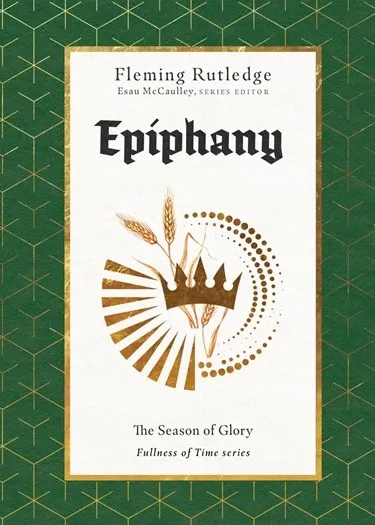
Epiphany is always January 6th in the western church. The season of Epiphany lasts from January 6th until Ash Wednesday. Since Easter determines Ash Wednesday and the season of Lent is always a set number of days and Easter varies, the season of Epiphany varies in length. This year, it is shorter than normal. This means the number of Sundays within the season are less this year and thus there are more Epiphany Season Sunday Scriptures and Collects to choose from. Our church used the Baptism of Jesus Scriptures and Collects on January 7th, which was the first Sunday. This is typical. But, the Cathedral in Jacksonville used different Epiphany Season Sunday Scriptures and Collects on January 7th and used the Baptism of Jesus Sunday Scriptures and Collects on January 14th. I am not sure why they chose to move this to the second Sunday in Epiphany.
I fully recommend anything written by Fleming Rutledge. She is in her mid-nineties and her wealth of Scriptural understanding is very deep. Of those who are still alive, my ideal retreat would be to sit in a very small group with Fleming Rutledge, N. T. Wright, and Scot McKnight.
Here are some quotes from the book.
Epiphaneia in New Testament Greek means manifestation.
They are “epiphanies”—events of revelation not available to human beings without an act of God.
Any manifestation that reveals Jesus’ true identity occurs because the power of God is at work upon the eyes, ears, and hearts of the recipients.
We will approach the season of Epiphany (or theophany) by focusing on just one word: glory. The season following January 6 begins, continues, and comes to a climax with various epiphanies of the glory of Jesus Christ as the only begotten Son of God.
The season with its readings takes us through some of the highest epiphanies in the life and mission of Jesus, from the adoration of the Magi to the transfiguration, leaving us well prepared for the beginning of the Passion narrative on Ash Wednesday. “What child is this?” we sing at Christmastide. The season of Epiphany opens up the answer.
We know for certain that the liturgical calendar began to take shape in the first four centuries AD, but it did not become embedded in all formal Christian worship until the sixteenth century.
The liturgical calendar as we know it today goes back to the earliest centuries after Christ, but it was not formed overnight. The development of the interrelated festivals of Christmas and Epiphany is particularly convoluted, subject to heated debate, and as such best left to scholars.
What is known for certain is that by the fifth century AD four themes for the Epiphany had become firmly fixed in the greater part of Christendom: 1. The visit of the Magi 2. The baptism in the Jordan River 3. The miracle of the wine at the wedding at Cana 4. The transfiguration of Christ in the presence of his chosen disciples. The first three signs, the tria miracula, were well-established in Gaul by the fifth century.
The rhythm of the seasons, the repetition of the sequence year after year despite outward circumstances, the variety and richness of the Scripture readings, and, most of all, the story that the seasons tell in narrative progression throughout the year—all of this can be powerful for the nourishment of growth in grace.
Thus we may say that the calendar is edifying—providing instruction, guidance, and inspiration for the upbuilding of the church.
The progression of seasons, when all is said and done, is designed so that the members of Christ’s body may participate even now in his eternal life by rejoicing in his living presence, following him in our various vocations, enacting his teachings in our ministries, knowing him as our Savior, and above all glorifying him as Lord.
The Epiphany season is designed to replace minimalist notions of glory with the real thing.
The season of Epiphany is designed to show that there is no road to the glory of God through human seeking; it cannot be summoned by human endeavor. It cannot be repeated too often: it comes as pure gift. It is revealed only from God’s being, from his will and his self-revelation, for the salvation of his creatures.
Leave a Reply