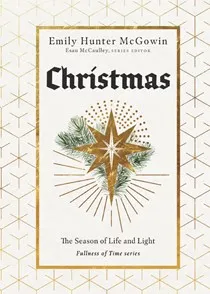
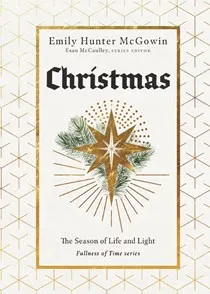
Yesterday, the 12 days of Christmas in the church’s liturgical calendar ended. Today starts Epiphany in the church’s liturgical calendar. During Christmastide, I read the book, Christmas: The Season of Life and Light, by Emily Hunter McGowin. This is another book from the Fullness of Time Series covering the church’s liturgical year.
Advent is a time of darkness awaiting in hope for the second coming of Jesus. Christmas is a time of celebrating Jesus piercing the darkness in his first coming. It is all about “Life and Light.” As i celebrated Christmas, I prayed for Jesus to again pierce the darkness through his people in the world.
In 2024, I want to continually pray for our world and our nation the Collect from this time which remembers the Slaughter of the Holy Innocents.
Receive, we pray, into the arms of your mercy all innocent victims; and by your great might frustrate the designs of evil tyrants and establish your rule of justice, love, and peace; through Jesus Christ our Lord, who lives and reigns with you and the Holy Spirit, one God, for ever and ever. Amen.
Since Ash Wednesday last year, I have read through the Fullness of Time Series. I have the Epiphany book left to read, which I started today. It is easy to “understand” the church’s liturgical calendar in a simple picture, but these books delve deeper into the theological meaning of the liturgical calendar. I would recommend them to anyone. They are less than 200 pages each and so each could be read in less than a week by most readers.
I would challenge most “American Evangelical” pastors to read these books because most of what you think you understand about the liturgical calendar is probably wrong. My understanding was definitely wrong and I graduated from an “American Evangelical” seminary.
Here are some of my highlights.
Christmas reveals to us the God of the great exchange, the God of the poor, the God of creation and re-creation, the God of life and light, the God of the crèche and the cross. “He came with Love,” indeed, and we are compelled to worship and serve him in return. Christmastide offers us one more way to do so.
Nevertheless, the church calendar ensures that, no matter how long and dark our Advent, the season of waiting always gives way to the season of wonder.
In the third century Clement of Alexandria writes that some calculated the day of the Lord’s birth to be today’s May 20 or April 20 or 21. One hundred years later, in the mid-fourth century, we find widespread consensus building around two dates: December 25 in the West and January 6 or 7 in the East.
early church fathers determined that the date of Jesus’ death (the fourteenth day of Nisan, according to the Gospel of John) in the year he died was equivalent to their March 25. Later the church recognized March 25 as the Feast of the Annunciation, which falls exactly nine months before December 25. So Jesus was thought to have been conceived and crucified on the same day of the year, with his birth occurring exactly nine months later.
Why would the church conclude that Jesus was conceived and killed on the same day? Some think it is rooted in ancient Jewish tradition about creation and redemption occurring in the same time of year.
Scholars convinced of the calculation theory think the same logic is at work in the Eastern dating of Christmas. But instead of the fourteenth day of Nisan in the Hebrew calendar, the Greek fathers used the fourteenth day of the spring month in the Greek calendar, which is our April 6. April 6 is exactly nine months before January 6, which was originally the Eastern date for Christmas (beginning at sundown). As a result, Christians in the East and West calculated the date of Jesus’ birth based on the belief that his death and conception took place on the same day, though due to their respective calendars, they came up with slightly different results.
What better embodiment of the Feast of the Incarnation could there be than standing before God, in the company of God’s people, with hands open and outstretched to receive the gift of God’s own self in the flesh and blood of Christ? With our festivities properly framed in the worship of the Word made flesh, our gift exchanges will speak more clearly of the great exchange God has undertaken on our behalf.
The mystery of the incarnation is, in Gustavo Gutiérrez’s words, “an incarnation into littleness”—transcendent power taking on mortal weakness amid a violent world.
The good news of great joy is for “all the people.” All the people. And the Messiah-Lord is born in a first-century town with a particular history among a peculiar people—the descendants of Abraham, Moses, and David. Thus, the universal liberator of all nations comes to us through the particularity of a powerless and marginalized nation.
It can be tricky to talk about wealth and poverty in the contemporary world. On the one hand, those in wealthy societies like the United States are increasingly aware of the disparity between our very high standard of living and the majority of the global population. Many Christians find themselves scandalized by the degree to which their relatively comfortable lives seem to be built on the unjust treatment and deprivation of people in other parts of the world. Lacking the power to do much about these global realities, Christians struggle to know what faithfulness to Jesus requires. Even within affluent countries, significant numbers of people lack the basic necessities of life. After all, the opposite of poverty is not wealth but enough. The poor are those who don’t have enough food and clean water, shelter and physical safety, medical care, and the like. Given the economic precariousness of late-modern capitalism, even those living in affluent areas can find themselves in situations where they are no longer able to meet basic needs. During Christmastide, followers of Jesus are reminded of their special obligation to care for those who lack “enough.”
At the same time, Christians know that material neediness isn’t the only kind of poverty. There is also poverty of virtue; scarcity of faith, hope, and love; and destitution of spirit that can plague human beings regardless of their material conditions. This is not to undermine the seriousness with which we should take the material needs of people, but it is to acknowledge that modern life, with all of its benefits and luxuries, has also brought with it an extraordinary prevalence of spiritual poverty.
Leave a Reply