In my previous post called, Rock Stars and Concerts, I shared my longings for a new vision of gatherings of the people of God:
- Opportunities to be led into the throne room of heaven with all of the saints living and dead. To use all of our bodies to express devotion to King Jesus. Guided by Scripture readings, petitions, awe-invocations, praises, laments and imprecations. To transition to focus on the “Lamb” and to commemorate his sacrifice with communion.
I am discovering that my “new” vision is an “ancient” tradition going back to the first 100 years of the gatherings of the people of God.
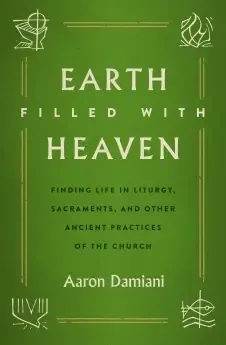
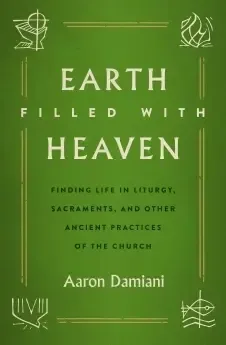
In the book, EARTH FILLED WITH HEAVEN: FINDING LIFE IN LITURGY, SACRAMENTS, AND OTHER ANCIENT PRACTICES OF THE CHURCH, Aaron Damiani had a similar journey to the ancient. He explores the high-level reasons behind the liturgical practices. Although I have been exploring this on my own with other resources, this is a great summary book that helped me put together the pieces.
Here are some highlights from the book
- On our way to see Jesus face to face, the sacramental life helps us experience His presence in a tangible way.
- What would it look like for us to deepen our roots and tap into an underground, ancient spring of our life in Him? What would it look like for our faith to flourish in the harsher conditions, offering shelter to spiritual pilgrims looking for shade? What would it look like for the church to not escape the culture, but be fruitful within it? What would it look like to not abandon the grace of God, but to drink more deeply from it?
- The secular age has left us with growing chaos, loneliness, boredom, anonymity, hopelessness, and polarization.
- As we practice the sacramental life in the spirit of Jesus, we find that chaos gives way to meaning, loneliness gives way to family, and polarization gives way to peace.
- It’s funny, I had always heard that liturgy and formalities in church were works-based salvation: an empty set of rituals that alienated people from the grace of Jesus. Yet for me, it was the opposite. The historic forms and seasons of the church, including the church calendar and frequent Communion, put the grace of Jesus on full display. It gave me a way to participate in that grace with my kneeling knees, my gazing eyes, my chewing mouth, and my praying voice. It was like that “easy yoke” Jesus talked about with His disciples. It fit, light and easy-like; the longer I wore it, the more I learned of His gentle and lowly heart for me—not just in my head, but in my muscle memory. My soul started to rest, week by week.
- The sermon did not have to be the main event that draws everyone back the next week. The preaching could simply be the gospel verbalized, and the sacraments (the Lord’s Table and baptism) could be the gospel visualized, working in tandem.
- Jesus created matter; Jesus became matter; matter matters to Jesus Christ.
- Suffice it to say, faith in Jesus Christ does not take us out of the world of food, clothes, drink, and conversation. Rather, it transforms the world of food, clothes, drink, and conversation.
- The heart of the Daily Office is not legalism and rigidity, but an invitation for people from every walk of life to work and rest as God’s creatures. It’s the metronome that keeps us on beat with God’s grace.
- A pilgrimage can be a literal trip you take, to the Holy Land where Jesus lived and died, or to hike the Camino Trail in Spain, or even the simple act of going to church to worship.
- What if, in a time of great change and disruption, our prayer and worship life became more rooted, ancient, and filled with prayers from Scripture?
- What if instead of alienating us from the presence of God, liturgical services caught us up into the throne room of God with confidence?
Leave a Reply